
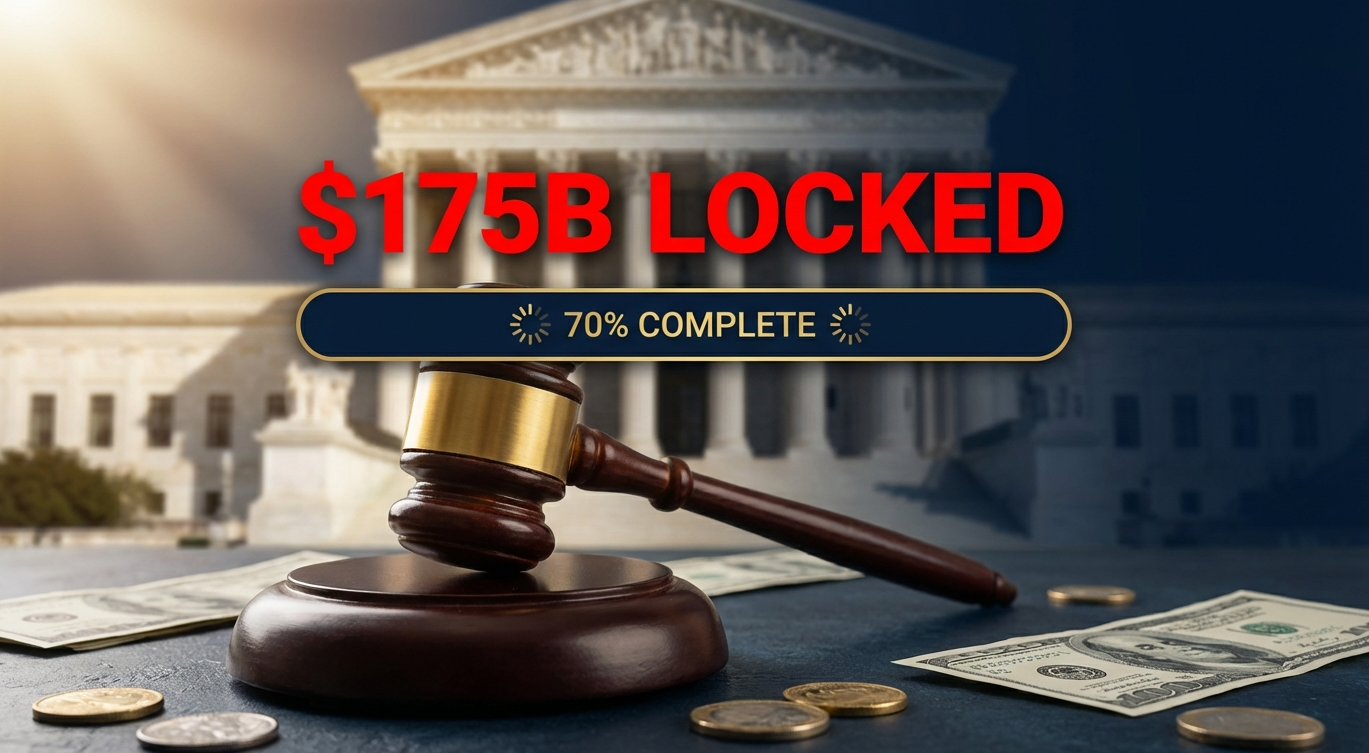
Supreme Court ruled IEEPA tariffs invalid, but $175B in refunds remain locked as CBP's CAPE system sits only 70% complete. What importers need to know about deadlines and recovery options.
The Supreme Court ruled 6-3 on February 20, 2026 that President Trump lacked authority to impose tariffs under the International Emergency Economic Powers Act (IEEPA). Six weeks later, the $175 billion businesses paid in those tariffs remains locked in government coffers. If you imported goods from China, Canada, Mexico, or virtually any other country between February 2025 and January 2026, you likely paid these now-invalidated duties. The question isn't whether you're owed money. It's when you'll actually see it.
The delay comes down to one system: CBP's Consolidated Administration and Processing of Entries (CAPE), which is only 70% complete as of late March 2026. Until it launches, mass refunds aren't happening.
In Learning Resources, Inc. v. Trump, the Court's majority opinion was unambiguous: IEEPA grants the president emergency economic powers, but those powers do not include imposing tariffs. The statute, written in 1977, was never designed to be a backdoor to unilateral trade policy.
The numbers are staggering. According to Penn Wharton Budget Model analysis, IEEPA tariffs generated roughly $175 billion in collections between January 2025 and January 2026. That represented half of all U.S. customs duties during that period. Half.
The tariffs started with China in February 2025, expanded to Canada and Mexico a month later, and by April 2025, they applied to imports from nearly every trading partner. China accounted for between 24% and 100% of IEEPA revenue depending on the month, with Canada, Mexico, and others contributing larger shares as the tariff regime expanded.
So the legal victory is complete. The constitutional question is settled. But legal victory and actual money in your bank account are two different things.
Customs and Border Protection (CBP) knew this ruling was coming. The agency began developing CAPE within the Automated Commercial Environment (ACE) portal months ago. But building a system to process potentially hundreds of thousands of refund claims, totaling $175 billion, is not simple work.
CAPE has four integrated components:
As of March 2026, CBP reports the system is 70% complete. The target launch date is mid-April 2026. But that's an estimate, not a guarantee.
The Court of International Trade (CIT) acknowledged this reality on March 6, 2026, when it suspended the requirement for immediate refunds while CBP finishes CAPE development. The court essentially said: the government owes this money, but we're giving CBP time to build the infrastructure to pay it.
That's cold comfort if you're a small business that paid these tariffs out of operating capital and needs those funds back.
We help businesses identify their IEEPA exposure and calculate potential refund amounts at no cost.
→ Get Your Free Refund Assessment at TariffRefundAuthority.com
Here's a significant development that hasn't gotten enough attention. On March 27, 2026, the CIT issued an order expanding refund eligibility to include finally liquidated entries, not just pending ones.
This matters because liquidation is when CBP finalizes duty assessment on an import entry. Many entries from early 2025 have already been liquidated. There was real concern that businesses with liquidated entries might face additional hurdles or even miss out entirely.
The March 27 order clarifies that liquidation status doesn't disqualify you. If you paid IEEPA tariffs, you're potentially eligible for refunds regardless of whether your entries have been finalized.
This expansion affects a substantial number of importers, particularly those who brought goods in during the first months of IEEPA tariffs on Chinese imports in early 2025. The timeline of Trump tariffs shows just how many businesses were caught in those early rounds.
Our team manages ACH enrollment, entry review, data reconciliation, and claim filing so you don't have to.
→ Start Your Refund Claim at TariffRefundAuthority.com
Here's what the government hasn't publicized: your protest deadlines don't pause while CBP builds its system.
Under standard CBP procedures, importers have 180 days after goods are liquidated to file a protest (CBP Form 19) requesting a refund. That clock started ticking on your earliest entries regardless of whether CAPE exists yet.
Some entries from the first IEEPA tariffs on China in February and March 2025 have already been liquidated for months. If you haven't taken action on those entries, your 180-day windows may be closing.
The CAPE system, when it launches, should streamline the process for entries that are still within their protest windows. But it won't resurrect claims where deadlines have already passed.
This creates an uncomfortable situation: the government is asking importers to wait for an automated system, but the waiting itself carries legal risk for entries with expiring deadlines.
The importers who will recover their money fastest are the ones preparing now, before CAPE goes live.
First, they're documenting everything. That means pulling entry summaries, duty payment records, and commercial invoices for every shipment that incurred IEEPA tariffs. The CAPE validation engine will require this documentation to verify claims.
Second, they're setting up ACH refund capabilities with CBP. Here's a troubling statistic: only 6% of affected importers have electronic refund capability configured in ACE. When CAPE launches and mass refunds begin processing, importers without ACH setup will face additional delays while they get their banking information into the system.
Third, they're calculating their actual exposure. Many businesses paid these tariffs through customs brokers and may not have a clear picture of exactly how much they're owed. That calculation requires analyzing duty payments by entry, identifying which specifically were IEEPA-based, and totaling them up.
Fourth, and perhaps most importantly, they're watching their liquidation dates. Entries that haven't been liquidated yet are the easiest to handle once CAPE launches. Entries that liquidated months ago require immediate attention to ensure protest deadlines aren't missed.
For many businesses, the timing problem is as serious as the legal complexity. You paid these tariffs twelve to eighteen months ago. You've already absorbed that hit to your cash flow. And now you're being told the refund system won't be ready until mid-April at the earliest, with actual disbursements potentially taking months longer.
Some importers are choosing not to wait.
A secondary market has developed for IEEPA tariff refund claims. Businesses can sell their claim rights to qualified buyers and receive immediate cash, typically a percentage of the estimated claim value. It's not the full refund amount, but it's money now rather than money in six months or longer.
This isn't for everyone. If your cash position is solid and you can afford to wait for full recovery, waiting makes financial sense. But if those tariff payments created inventory problems, forced you to delay expansion, or are currently sitting as accounts receivable that you need to convert to working capital, claim monetization is a legitimate option.
The transaction is straightforward: you assign your refund rights, you receive payment, and the buyer assumes responsibility for pursuing the claim through whatever process CBP ultimately implements.
Find out what your refund claim is worth today. We provide free, no-obligation valuations for businesses exploring immediate payment options.
→ Get Your Free Claim Valuation at TariffRefundAuthority.com
The mid-April 2026 target for CAPE is CBP's current projection, but it's not a firm deadline. System development can slip, particularly when the stakes involve $175 billion in government disbursements.
Once CAPE launches, the sequence will likely be:
The CIT will continue monitoring implementation and may issue additional orders if CBP misses deadlines or if procedural issues emerge.
Meanwhile, Congress has shown interest in the broader implications of the ruling. The IEEPA tariff invalidation represents a significant check on executive trade authority, and there's ongoing debate about whether Congress should pass legislation either codifying or limiting presidential tariff powers going forward. None of that affects your existing refund claims, but it does suggest the trade policy environment will remain unsettled.
Join our update list and we'll notify you of new rulings, CBP guidance, portal launch dates, and filing deadlines as they happen.
→ Join the Update List at TariffRefundAuthority.com
The Supreme Court has spoken. You paid tariffs that were never legally authorized. That money is owed back to you.
But between legal victory and actual recovery lies a maze of CBP systems, CIT orders, protest deadlines, and documentation requirements. The government is building infrastructure to process your claim, but the burden of ensuring you don't miss deadlines or fail validation requirements falls on you.
Whether you want to file a professional claim, need to understand your deadlines, or want to explore selling your claim for immediate cash, Tariff Refund Authority can help.
→
→
Visit TariffRefundAuthority.com to get started.
Tariff Refund Authority is not a law firm and does not provide legal advice. We work with licensed customs brokers and trade attorneys. All services are facilitated through licensed customs brokers and qualified trade attorneys. Refund eligibility, amounts, and timelines are subject to ongoing litigation, government action, and administrative processes that may change. No refund outcome is guaranteed.

Stay up to date on tariff refunds.